
success story

Performance and Compatibility Crisis: Rescuing an Inefficient Banking Portal

Type
Legacy Rescue & Modernization
Year
2020 - Ongoing
success story
Legacy Rescue & Modernization
2020 - Ongoing
A major international bank contacted us to evaluate their messaging exchange portal.
This custom messaging system was used by clients to execute payment orders and
dispositive operations on their accounts—tasks that, once received, were
manually processed by back-office staff.
The client initially approached us for a technical assessment of the pre-existing software.
Following the evaluation, the decision was made to perform a feature-parity rewrite of the platform.
This choice was driven not only by the performance bottlenecks plaguing the legacy portal
but also by its poor compatibility with modern browsers and mobile devices.
These initial requirements, which began as a specific and targeted need, rapidly
evolved into a project of much greater scope.
The vision expanded from an immediate fix to a strategic goal: providing customers
with a comprehensive and autonomous digital experience.
This led to the development and implementation of a full-scale Home Banking portal.
A crucial aspect of the project was ensuring seamless integration with the bank's core sub-systems. We managed the complexity of interfacing with legacy systems by developing robust and secure APIs and connectors. These allowed the new portal to access essential transactional and master data in real-time, ensuring consistency and reliability for all end-user operations.
This integrated approach allowed the bank to modernize the user interface without having to overhaul its entire backend infrastructure.
Our solution was heavily informed by the use cases identified during brainstorming and requirement-gathering sessions.
To ensure operational stability under the expected user load, we developed a solution featuring two dedicated front-ends:
An interface for end-customers
A management dashboard for internal operators
Both portals communicate with a single, high-performance exchange backend that centralizes business logic and ensures data integrity. Particular attention was paid to data segmentation, ensuring that information is strictly partitioned based on the specific profiles of customers or operators.
Throughout these evolutionary phases, back-office operators were increasingly relieved of routine daily tasks, leading to the full automation of payment order transfers to other accounts.
The portal is currently under active management and development, gradually centralizing functionalities previously scattered across various legacy applications, providing both customers and staff with a single point of operation.
Additionally, during the initial development phase, we implemented a customized Identity Management solution (Keycloak) to support the bank's specific security protocols.
Today, this IDM system has been adopted by several other platforms within the bank beyond the internet banking portal.
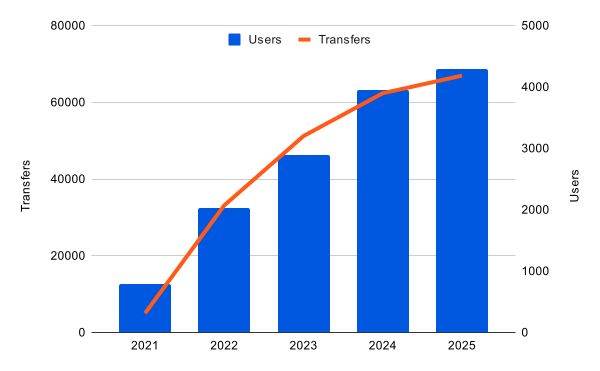
The decision to move beyond a simple technical assessment and proceed with a complete rewrite proved to be a winning strategy.
The new system not only resolved the performance and compatibility issues of the legacy software but also enabled an ambitious expansion into a comprehensive Home Banking platform.
The adoption of a dual front-end architecture, powered by a single high-performance backend, ensured a modern user experience for customers while drastically optimizing internal workflows.
Through core system integration and the progressive automation of dispositive processes, back-office staff have significantly reduced time spent on manual management, increasing the overall operational efficiency of the institution.
The new portal stands as a successful example of digital transformation, delivering tangible benefits in both customer service and internal operational excellence.





+ years
ongoing